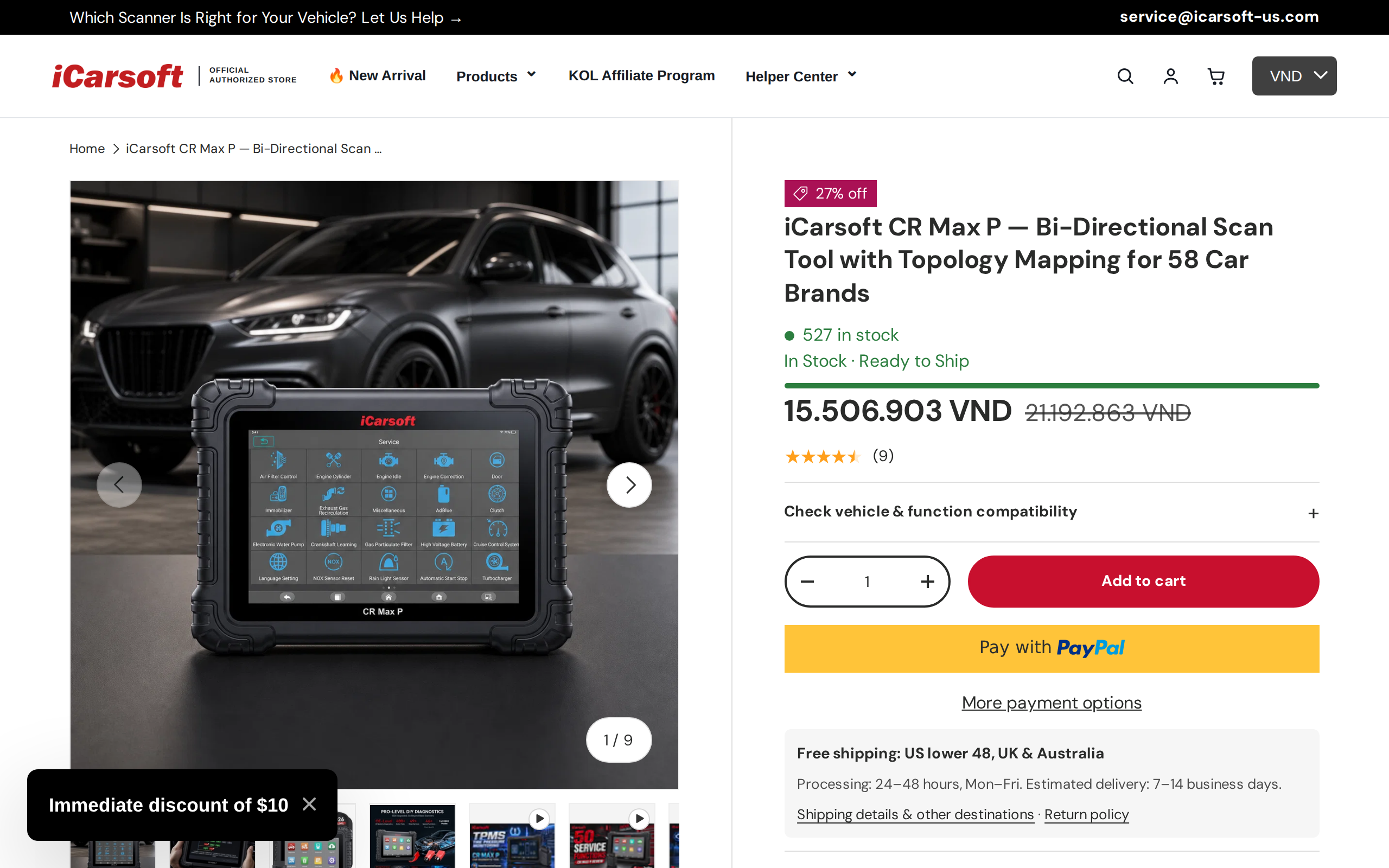
iCarsoft CR Max P Review: A Closer Look at This Bi-Directional Scan Tool with Topology Mapping
A desk review of the iCarsoft CR Max P for home mechanics: what bi-directional control and topology mapping mean in practice, and how the maker's published features fit a garage workflow.
Spec sheet
- Our score
- 8.8/10
- Maker
- iCarsoft
- Category
- Pro Diagnostic Tablets
- Tested
- Oct 28, 2026
On paper the CR Max P pairs active tests, a visual topology map and 50 listed service functions in one 10-inch tablet. We rate it 4.4 out of 5 from the maker's published information; topology, tests and coding depend on the vehicle, so check your car's function list first.
Best forHome garages that want bi-directional tests and a module mapAffiliate disclosure: We may earn a commission when you buy through links on this page, at no extra cost to you. This review is based on the manufacturer's published information.
How This Review Was Done
This is a desk review. We have not bought, used or tested the iCarsoft CR Max P, and nothing below describes a repair done with it. What we did was read the maker's own product page line by line, including the feature sections, the comparison tables, the specification table, the packing list and the FAQ, and then ask a simple question: if you are a home mechanic with one or two cars in the driveway, which of these claims would change what you do on a Saturday?
Every specification in this article is attributed to iCarsoft's published material, and where the maker words something with a caveat, we repeat the caveat instead of smoothing it away. We do not give accuracy figures, speed figures or promises about a particular car, because the manufacturer does not publish any we could check. The screenshots are captures of the maker's public product page, taken for this review, and each caption says what the picture actually shows.
The tool is sold through the maker's official US store. If you want to read the source material yourself, the iCarsoft CR Max P product page is where every figure below comes from.
iCarsoft CR Max P Review: The Short Version
The CR Max P is a 10-inch Android tablet with a wireless Bluetooth interface that plugs into the car's diagnostic port. iCarsoft pitches it around four ideas: full-system scanning, bi-directional (active) tests, a visual topology map of the car's control modules, and a long list of service functions. The maker lists lifetime free software updates over Wi-Fi and a one-year warranty.
Our rating on paper is 4.4 out of 5. The reason it scores well is that the feature set matches what a serious home mechanic actually runs into: a warning light that a cheap reader cannot explain, a part you want to command on and off before you replace it, and a service reset that would otherwise cost a trip to a shop. The reason it does not score higher is that the manufacturer is open about the fact that almost everything interesting is vehicle-dependent. Topology mapping, active tests, coding and service functions all come with a line saying that availability varies by make, model, model year and ECU configuration. A desk review cannot tell you whether your car sits on the good side of that line, and neither can we.
If you want to check your own vehicle before anything else, the manufacturer's function list and compatibility checker is the place to start, and iCarsoft says its support team will confirm compatibility on request.
What Is the iCarsoft CR Max P?
iCarsoft is a diagnostic tool brand that sells multi-brand scanners as well as make-specific ones. The CR Max P sits in its multi-brand, pro-grade range. The maker calls it the direct successor to the CR MAX BT and describes it as a flagship of the CR Max line, with a bigger screen, a larger battery and the newer communication protocols that recent cars use.
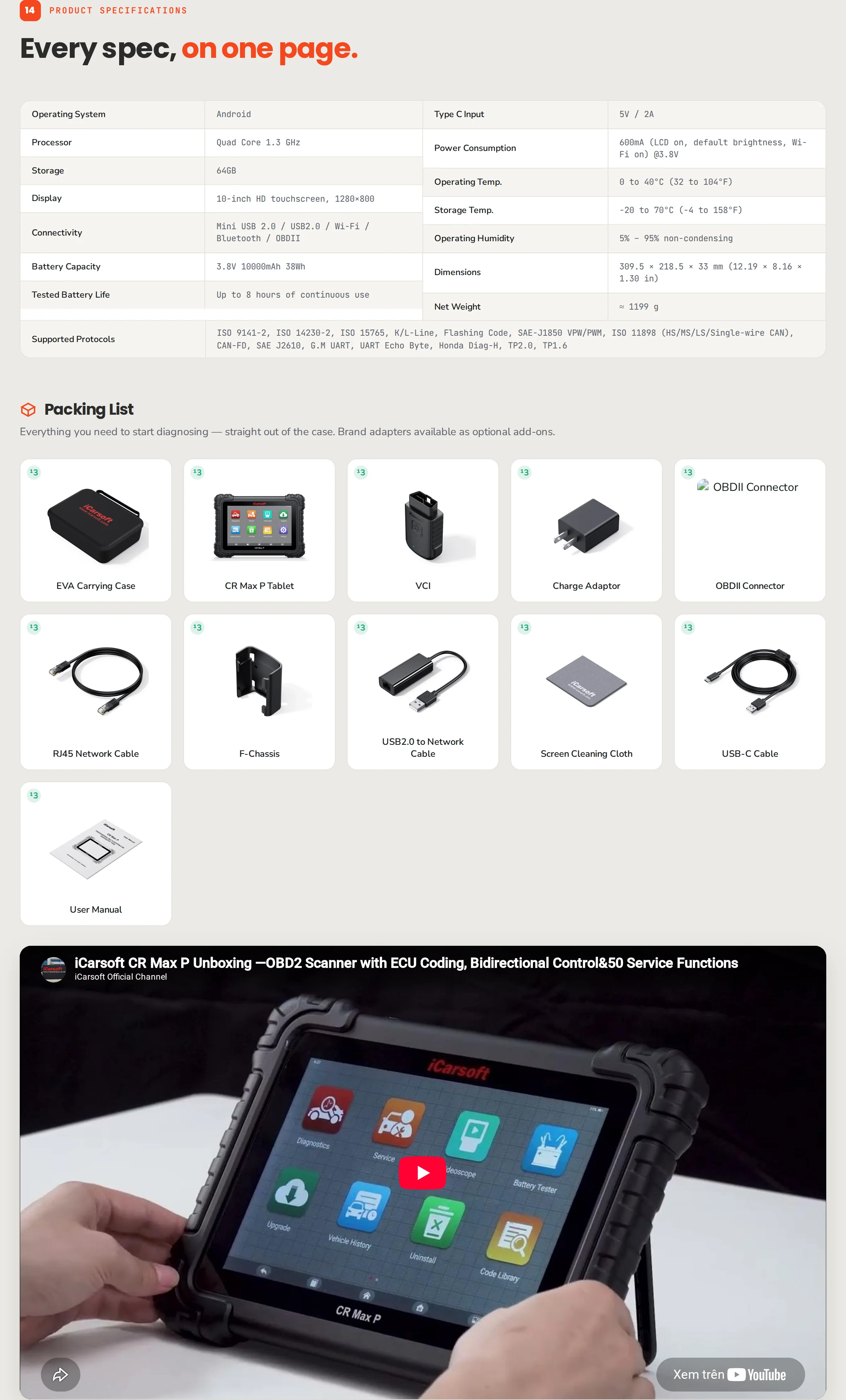
The numbers the maker publishes for the hardware are these:
- Display: 10-inch HD touchscreen, 1280 x 800
- Operating system: Android
- Processor: quad-core, 1.3 GHz
- Storage: 64 GB, with 1 GB of RAM mentioned in the FAQ
- Battery: 3.8 V, 10,000 mAh, 38 Wh, with up to 8 hours of continuous use quoted as tested battery life
- Dimensions: 309.5 x 218.5 x 33 mm, net weight about 1199 g
- Connectivity: Mini USB 2.0, USB 2.0, Wi-Fi, Bluetooth and OBDII
- Languages: 15, including English
Bi-Directional Control Explained in Plain English
A basic code reader is a listener. The car's computers keep a record of what they noticed, and the reader prints it out. A bi-directional scan tool can also talk back: it sends a command to a component and lets you watch whether the component responds. Manufacturers also call this an active test, an actuation test or a function test.
Here is why that matters in a garage. Suppose the engine cranks but will not start and you suspect the fuel pump. Without bi-directional control you have two options: assume, and buy a pump, or hunt for the relay, a fuse and a wiring problem with a multimeter. With it, you ask the car's computer to switch the pump on. If you hear it run, the pump is probably fine and the problem is upstream or elsewhere. If nothing happens, you have narrowed the search. The command does not replace thinking, but it removes a lot of guesswork and a few unnecessary parts purchases.
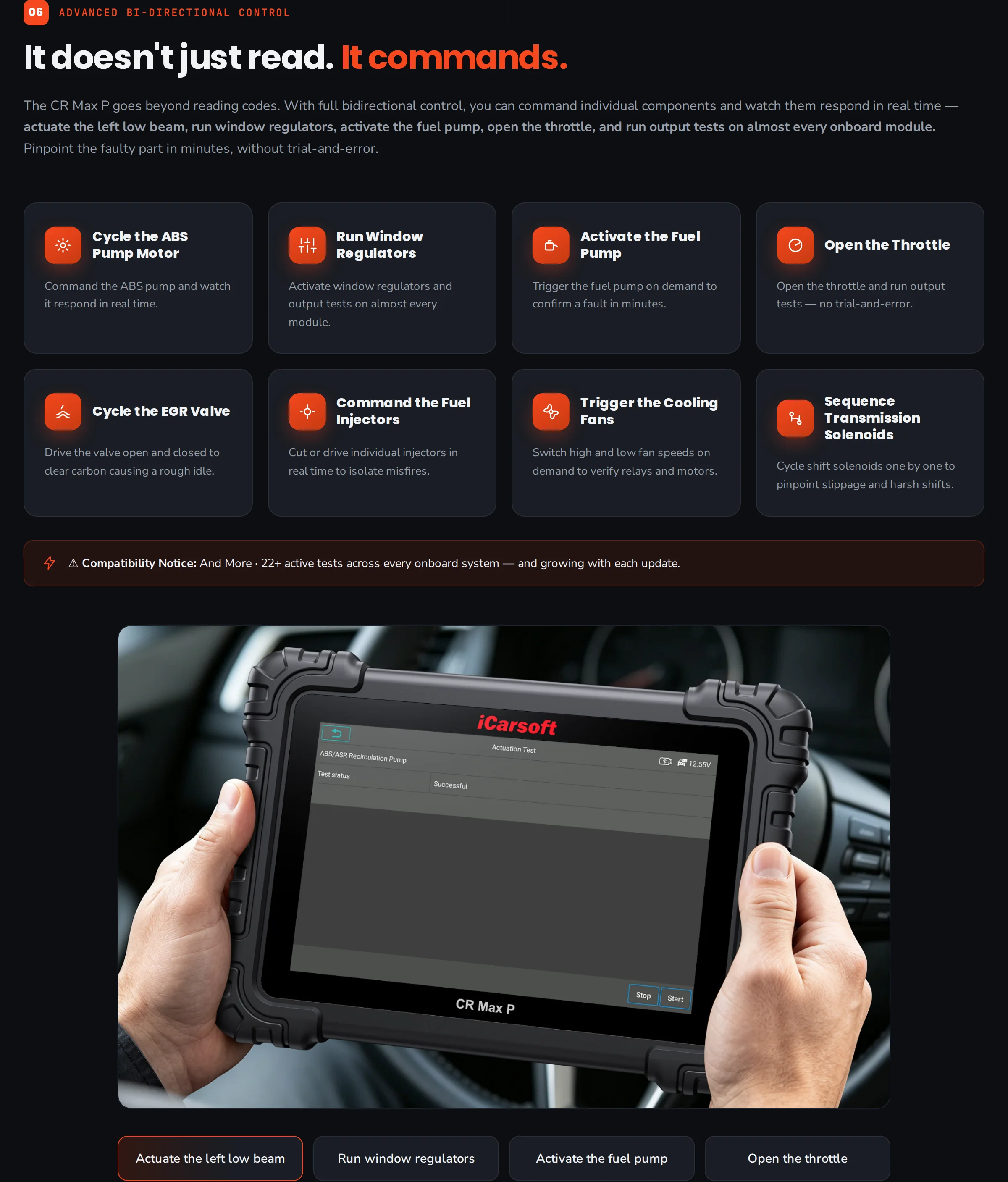
The maker's examples are concrete. Its page lists tests that cycle the ABS pump motor, run the window regulators, activate the fuel pump, open the throttle, cycle the EGR valve, cut or drive individual injectors, switch the cooling fans between high and low speed, and step through transmission shift solenoids one by one. It also mentions actuating the left low beam, and says there are "22+ active tests across every onboard system". The maker also says it can run output tests on "almost every onboard module".
iCarsoft CR Max P Topology Mapping: What It Shows
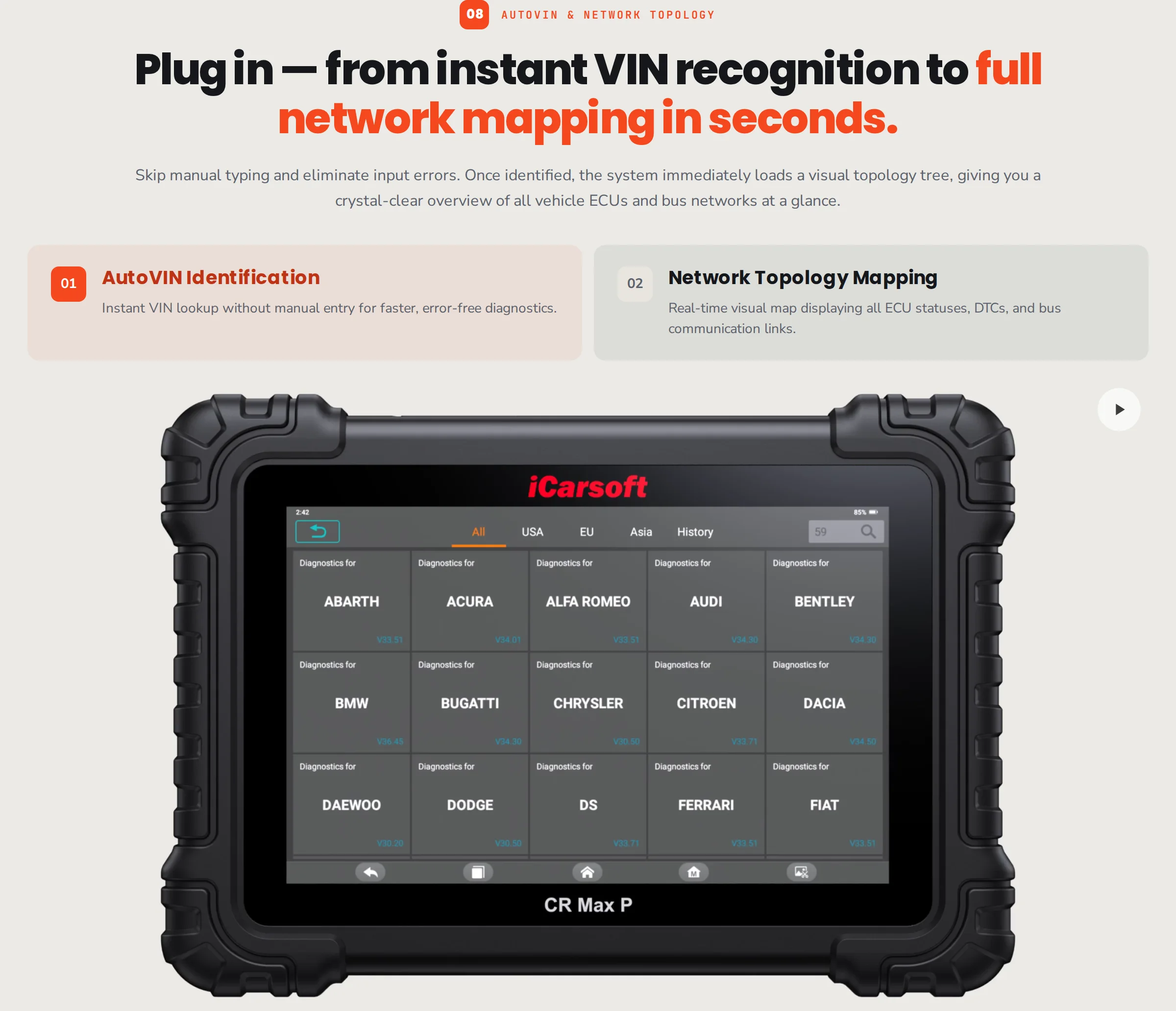
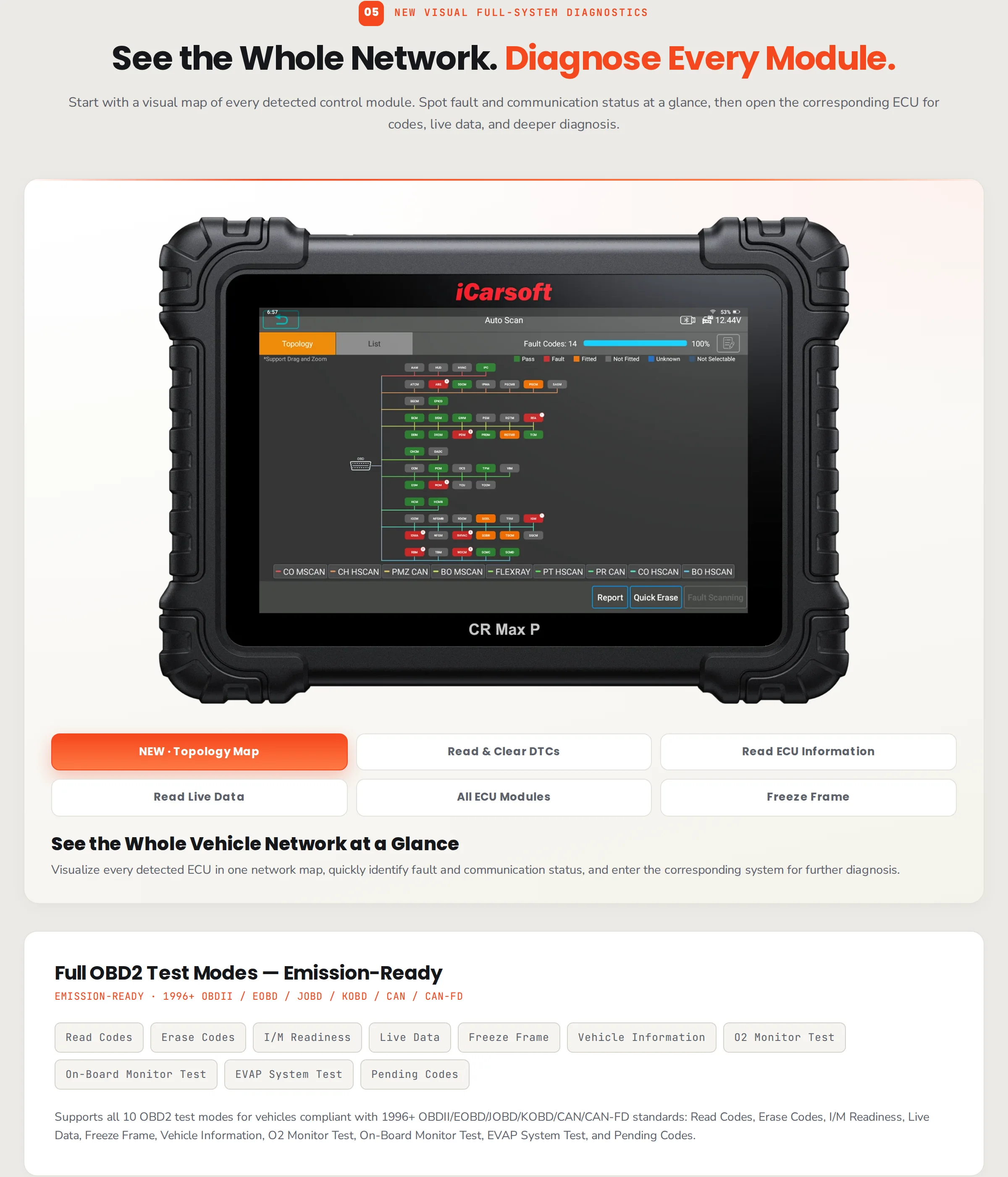
Topology mapping is the headline new feature, and the one the maker flags as new on the CR Max P compared with the CR MAX and CR MAX BT. A modern car is a small network. Dozens of control modules, for the engine, transmission, brakes, airbags, body electronics, climate and infotainment, talk to each other over several communication buses. A classic scan tool shows you those modules as a long menu: pick a system, read its codes, go back, pick the next one.
A topology map draws the network instead. iCarsoft describes it as a visual map of every detected control module, showing fault and communication status, from which you can go directly into the matching system for codes, live data and deeper diagnosis. The maker also describes the map as showing "all ECU statuses, DTCs, and bus communication links" in real time.
Why would a home mechanic care? Because of a very common trap. When one module drops off the network, the modules that depend on it often log "lost communication" codes of their own. On a flat list that can look like five separate faults. On a map it looks like one module that has gone quiet, and the five codes are symptoms. Whether the CR Max P draws that picture clearly in practice is something we cannot judge from a product page, but the idea is sound and it is the kind of aid that makes a complicated car feel less like a pile of unrelated menus.
Two caveats, both in the maker's own words. The comparison table carries the notice that topology mapping is "available on supported vehicles only", with availability varying by make, model, model year and ECU configuration. And the FAQ answers the obvious question directly: it is not on every vehicle, and where the topology view is not supported the tool can still perform the available full-system functions. If the map is the reason you are considering this tool, send your vehicle details to the maker and get a written answer before you rely on it. You can start from the CR Max P listing on iCarsoft's store.
Vehicle Coverage: What the Brand List Says
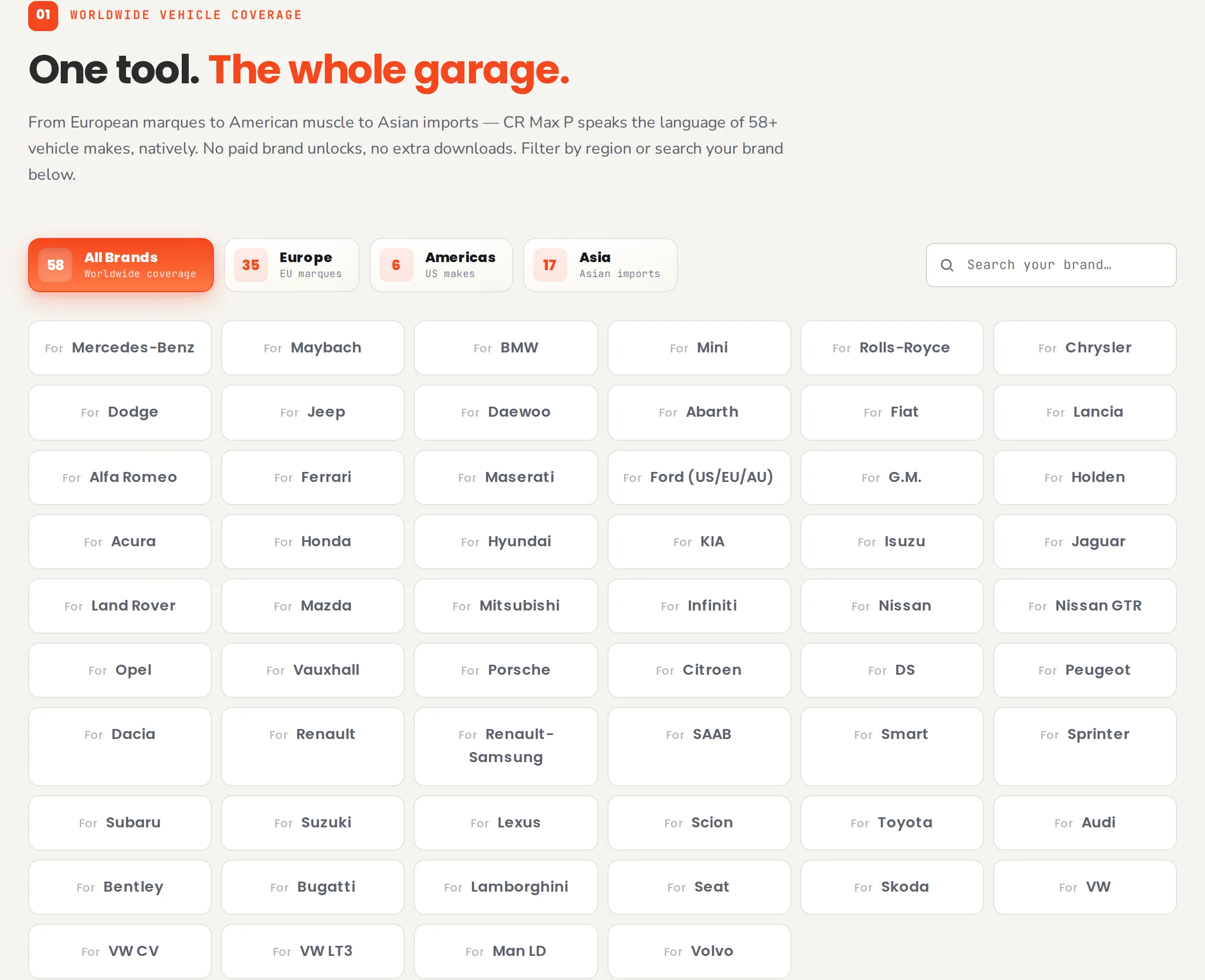
iCarsoft markets the CR Max P for 58 vehicle makes, and its page breaks them into groups. We repeat its wording and its grouping rather than adding anything of our own:
- European luxury: Mercedes-Benz, Maybach, BMW, Mini, Rolls-Royce, Porsche, Audi, Bentley, Bugatti, Lamborghini, Ferrari, Maserati, Volvo, Jaguar, Land Rover, Smart and Sprinter.
- European volume: VW, Seat, Skoda, SAAB, Opel, Vauxhall, Citroen, DS, Peugeot, Renault, Dacia, Fiat, Abarth, Lancia, Alfa Romeo and others on the list.
- Asian imports: Toyota, Lexus, Scion, Honda, Acura, Nissan, Infiniti, Mazda, Subaru, Suzuki, Mitsubishi, Hyundai, Kia, Isuzu and Daewoo.
- American: Ford, GM, Holden, Chrysler, Dodge and Jeep.
iCarsoft CR Max P Features at a Glance
Beyond bi-directional tests and the topology map, the maker's page covers service functions, ECU coding, reporting and hardware. This is the part of the product page we would read twice.
Service functions
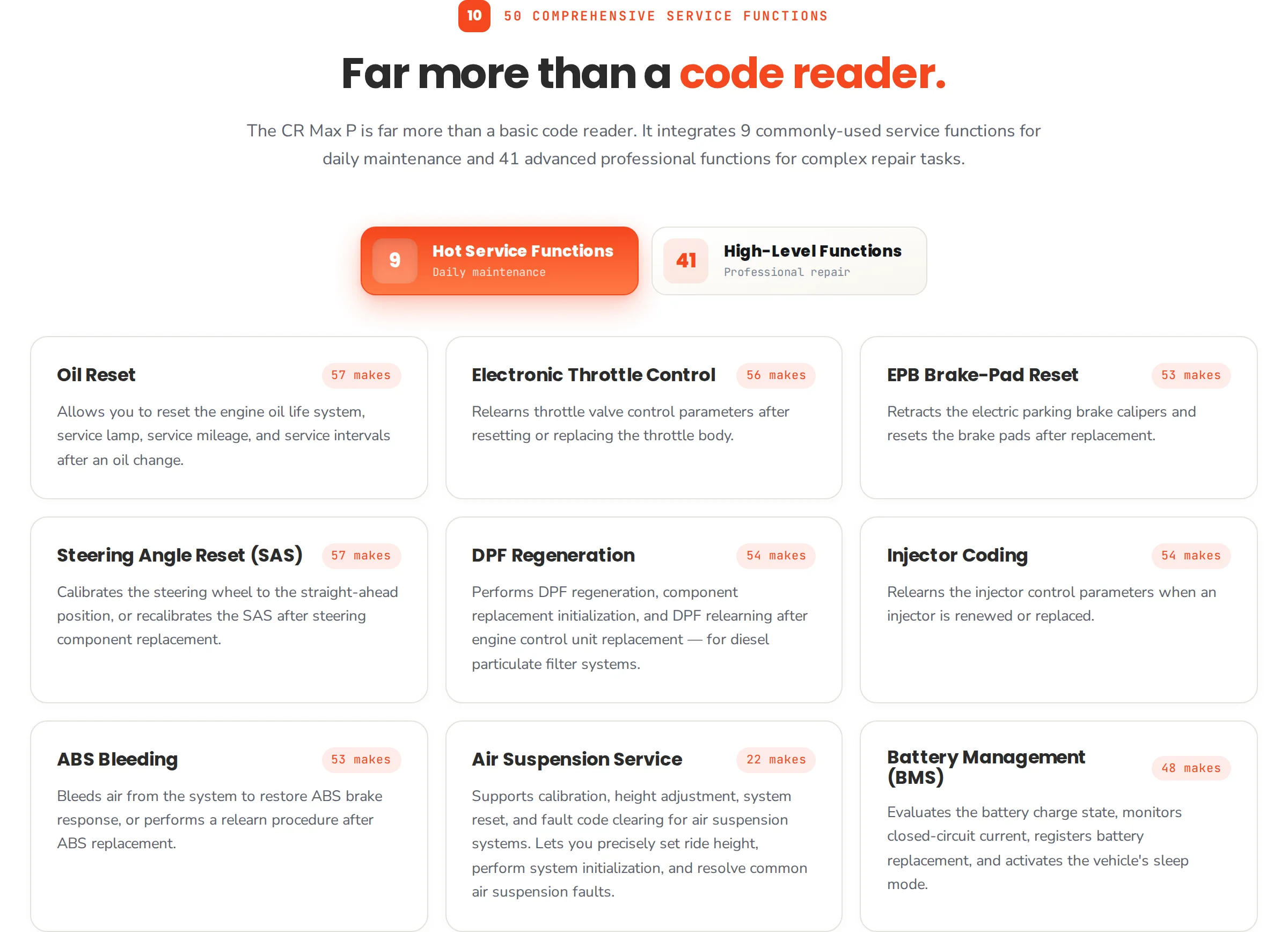
The maker says the tool has 50 service functions: nine "hot" functions for daily maintenance and 41 more advanced ones. (Elsewhere on the same page a FAQ answer says "49+", which is a small inconsistency worth knowing about, so treat the exact count as the maker's marketing number and check the function list for your car.) The nine everyday functions, with the number of makes the maker says each one reaches, are:
- Oil reset: 57 makes
- Electronic throttle control relearn: 56 makes
- Electric parking brake pad reset: 53 makes
- Steering angle reset: 57 makes
- DPF regeneration: 54 makes
- Injector coding: 54 makes
- ABS bleeding: 53 makes
- Air suspension service: 22 makes
- Battery management, including registering a replacement battery: 48 makes
ECU coding
The page promises ECU coding across "8+ major car groups", including BMW from 2006, the VAG group from 2010, Hyundai and Kia from 2010, Ford from 2003 to 2023, Renault, Mazda and Subaru, with uses such as matching a replacement module and switching hidden comfort features. Coding is where a mistake can leave a module misbehaving, so write down the original values first and follow a procedure written for your exact car.
From Driveway to Shop: A Typical Diagnostic Workflow
1. Connect and identify. Plug the VCI into the 16-pin port, turn the ignition on, and pair the tablet by Bluetooth. The maker's FAQ says to look for the VCI named for the CR Max P and wait for a green icon. Then let AutoVIN read the vehicle, or pick the make manually if it does not.
2. Look at the whole car first. On a supported vehicle, start from the topology map rather than a single system. Which modules show faults? Which ones are not communicating at all? A silent module explains a lot of secondary codes, and the map is designed to show that at a glance. If the car is not supported, the maker says you can still run the full-system functions.
3. Read, record, then clear. Open the module with the fault and read the codes and the live data. The FAQ advises recording freeze frame data before clearing codes, and keeping the ignition on with the engine off while you do it. That advice is sound for any tool: a cleared code with no notes leaves you nothing to compare against.
4. Command the suspect part. This is where bi-directional control earns its place. If the fault points at a fan, a pump, a valve or an injector, run the active test and observe. A part that answers the command moves the suspicion to wiring, a relay or a sensor. A part that stays silent moves it back to the part.
5. Finish the repair with a reset. After replacing a part, run the matching service function: retract and reset the electric parking brake, register a new battery, relearn the throttle, bleed the ABS circuit, or reset the oil service light. Then clear the codes, save a report, and take a final look at the map to confirm that nothing is complaining.
OBD2 Basics and Emissions Readiness
Underneath all the advanced features sits the part every scan tool does: standard OBD2. The EPA overview of on-board diagnostics (OBD) explains the system that has been standard on light-duty vehicles in the United States since the mid-1990s: your car monitors its own emissions-related parts, lights the check engine lamp when something goes wrong, and stores a code you can read through the 16-pin port.
The maker says the CR Max P supports all ten OBD2 test modes on vehicles that comply with 1996-and-later OBDII, EOBD, JOBD, KOBD, CAN and CAN-FD standards. The list it gives is: read codes, erase codes, I/M readiness, live data, freeze frame, vehicle information, O2 monitor test, on-board monitor test, EVAP system test and pending codes.
iCarsoft CR Max P vs Other iCarsoft Models
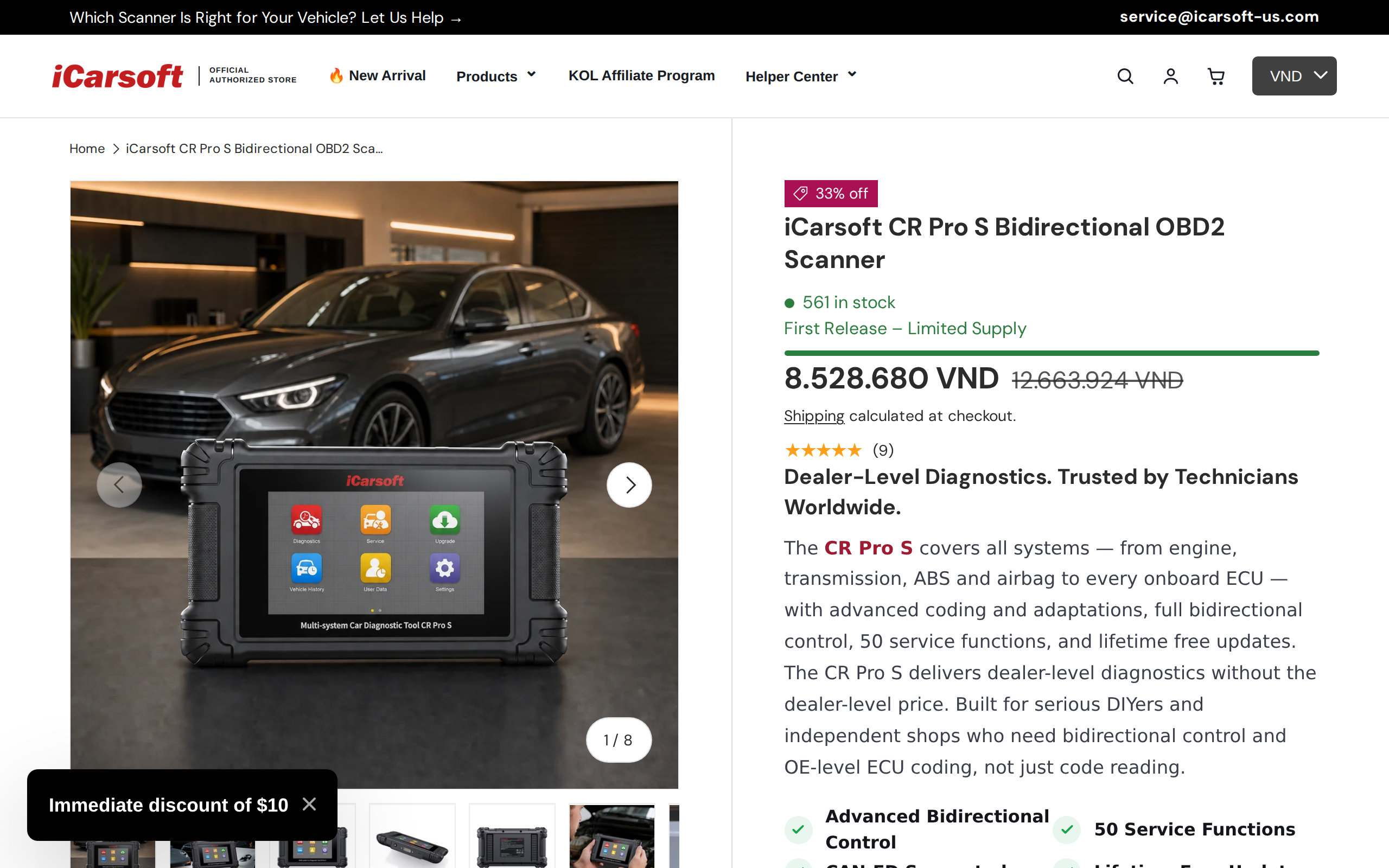
iCarsoft's own comparison tables lay the family out as two upgrade paths, so it is easy to place the CR Max P.
CR MAX and CR MAX BT. The maker's table lists both as 7-inch tools with 58 makes, full-system access, bi-directional tests, AutoVIN, 50 service functions and free lifetime updates, with the CR MAX on a cabled OBD connection and the CR MAX BT on wireless Bluetooth. Against the CR Max P, the table shows a 10-inch display, DoIP as standard instead of optional, and visual topology mapping as the only feature marked as new. The FAQ summarises the upgrade as a 10-inch touchscreen, a quad-core processor, 64 GB of storage, a 10,000 mAh battery and the DoIP cables in the box.
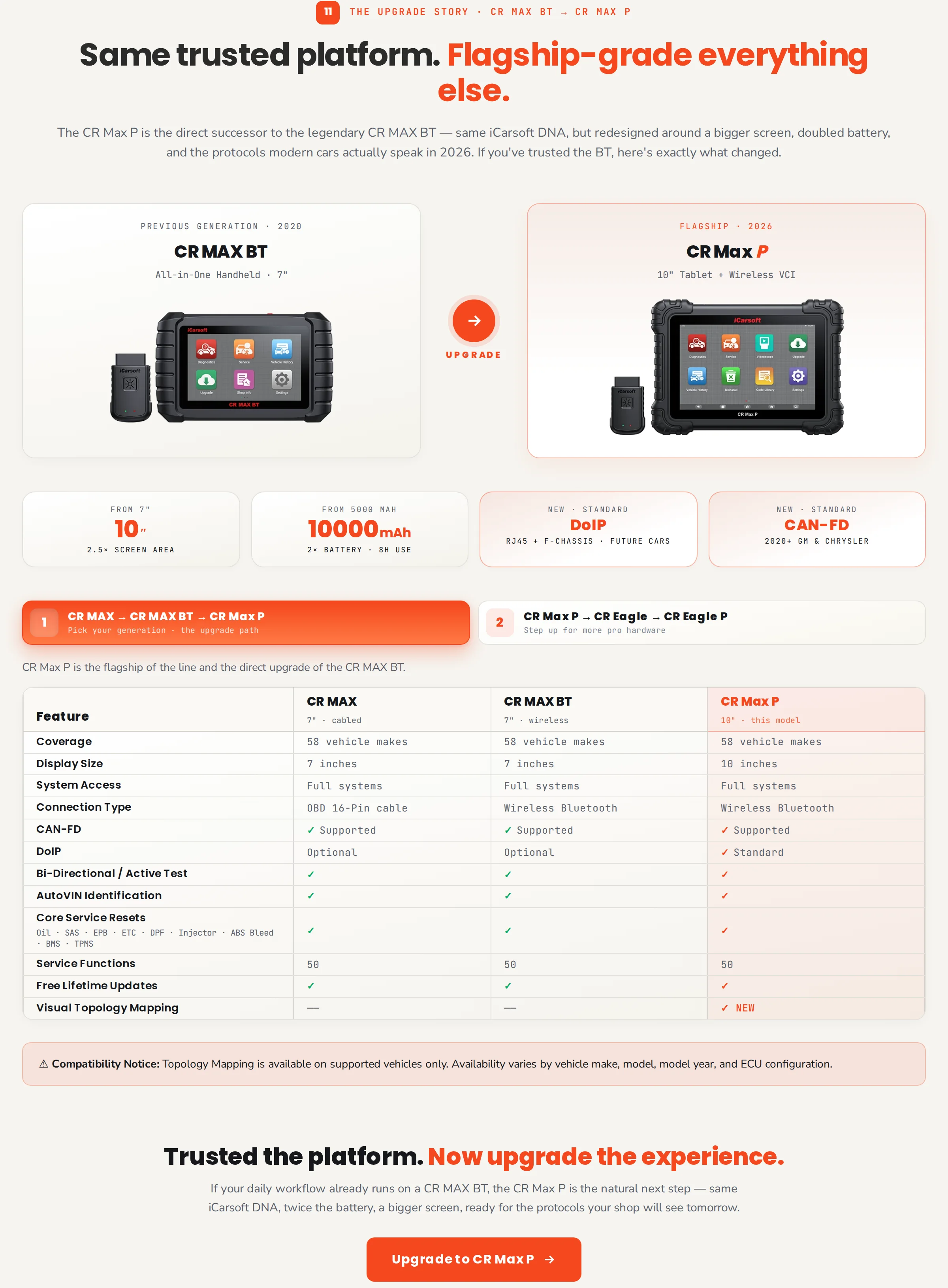
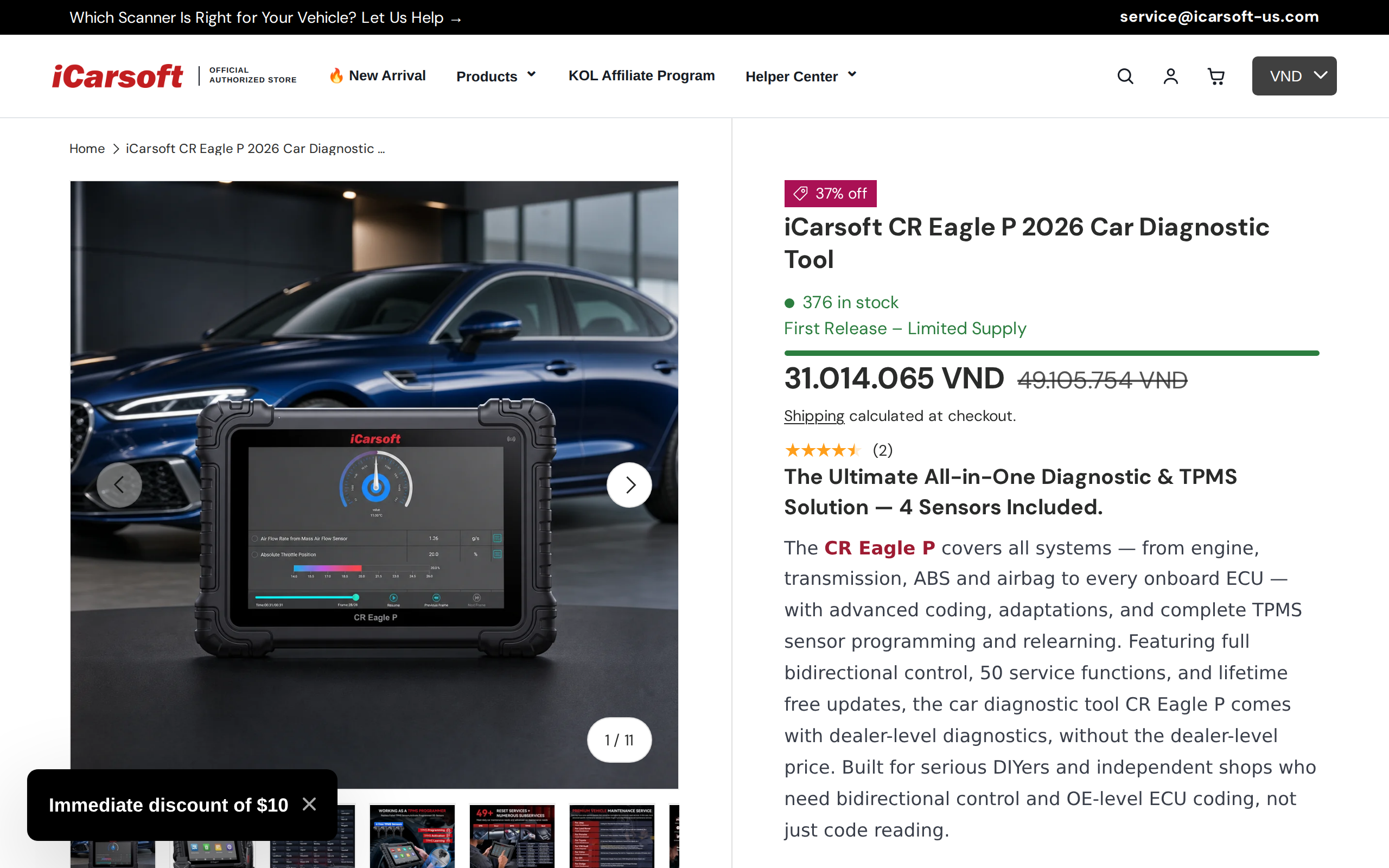
CR Eagle and CR Eagle P. The second table describes the Eagle models as sharing the same diagnostic engine and adding pro hardware. The differences it lists are 128 GB of storage against 64 GB, a Wi-Fi connection type, a J2534 protocol entry, and extras such as a videoscope, battery clips, TPMS sensors and a larger set of included OBD1 adapters in the full-kit version. For a home mechanic that is a package question more than a software one: if you do not need the extra hardware in the box, the CR Max P is the one that matches the core feature list.
Our position, from the paper alone: the CR Max P is the most sensible place to start in this line for someone who wants bi-directional control and does not want to pay for hardware they will not use. The topology map is the only genuinely new idea over the older CR MAX BT, and it is conditional on vehicle support, so decide whether that single feature justifies the move. If your car is a modern one on a supported network, we think it probably does. If you only need to read codes and reset an oil light, a simpler iCarsoft model or any basic OBD2 reader will do the job.
Before you decide, check your vehicle against the maker's list and ask support about the exact functions you want. The iCarsoft store is where that compatibility check starts.
Final rating: 4.4 out of 5 based on the manufacturer's published features. That score reflects a well-chosen feature set and an honest set of caveats on the maker's own page, and it will move only once someone has used the tool on a real car.
What worked, what did not
Pros
- Bi-directional tests: ABS pump, fuel pump, fans, injectors and more
- Visual topology map of control modules on supported vehicles
- 50 listed service functions including oil, EPB, SAS and battery
- 10-inch Android tablet, 10,000 mAh battery, about 8 hours
- CAN-FD and DoIP support with the cables in the box
- Lifetime free Wi-Fi updates and a one-year warranty
Cons
Specifications
- Display
- 10-inch HD touchscreen, 1280 x 800
- Operating system
- Android
- Processor and storage
- Quad-core 1.3 GHz, 64 GB
- Battery
- 3.8 V, 10,000 mAh, up to 8 hours
- Weight
- About 1199 g
- Vehicle makes
- 58
- Service functions
- 50
- Connectivity
- Bluetooth, Wi-Fi, USB 2.0, OBDII
- Updates and warranty
- Lifetime free updates, 1-year warranty